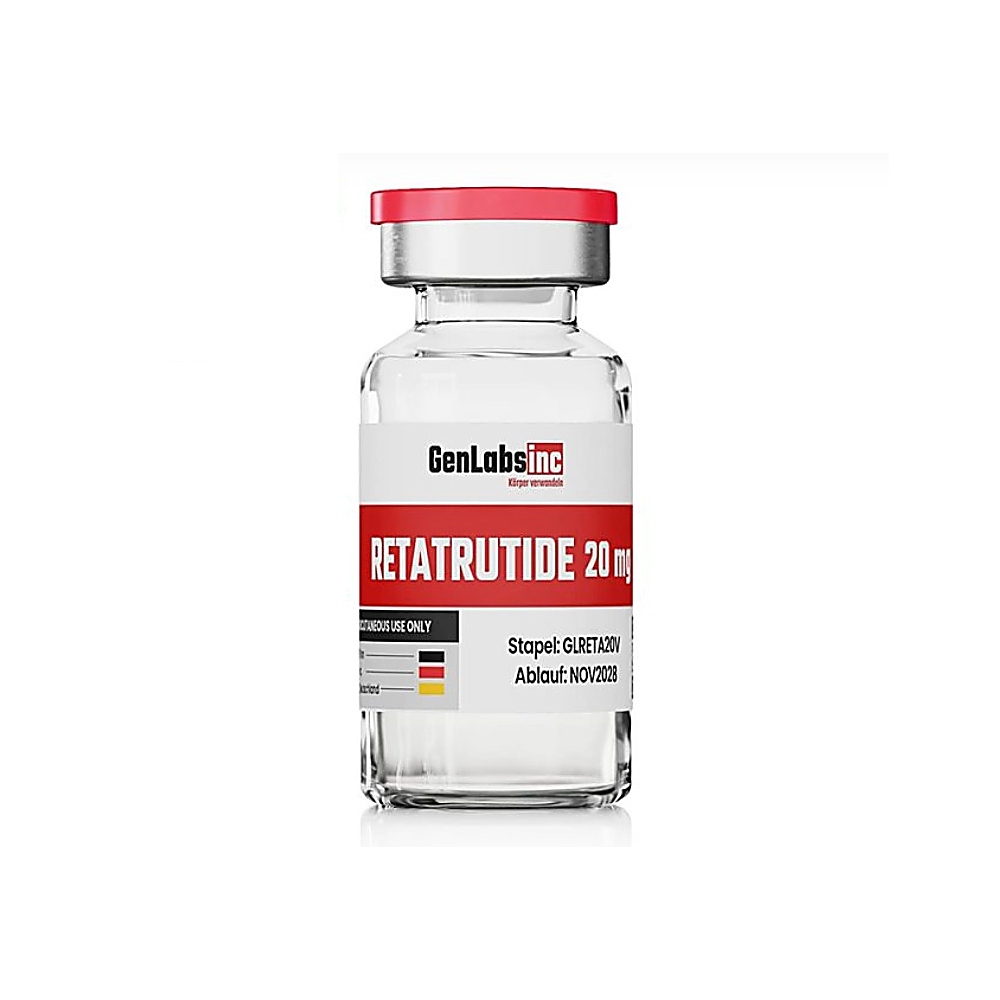
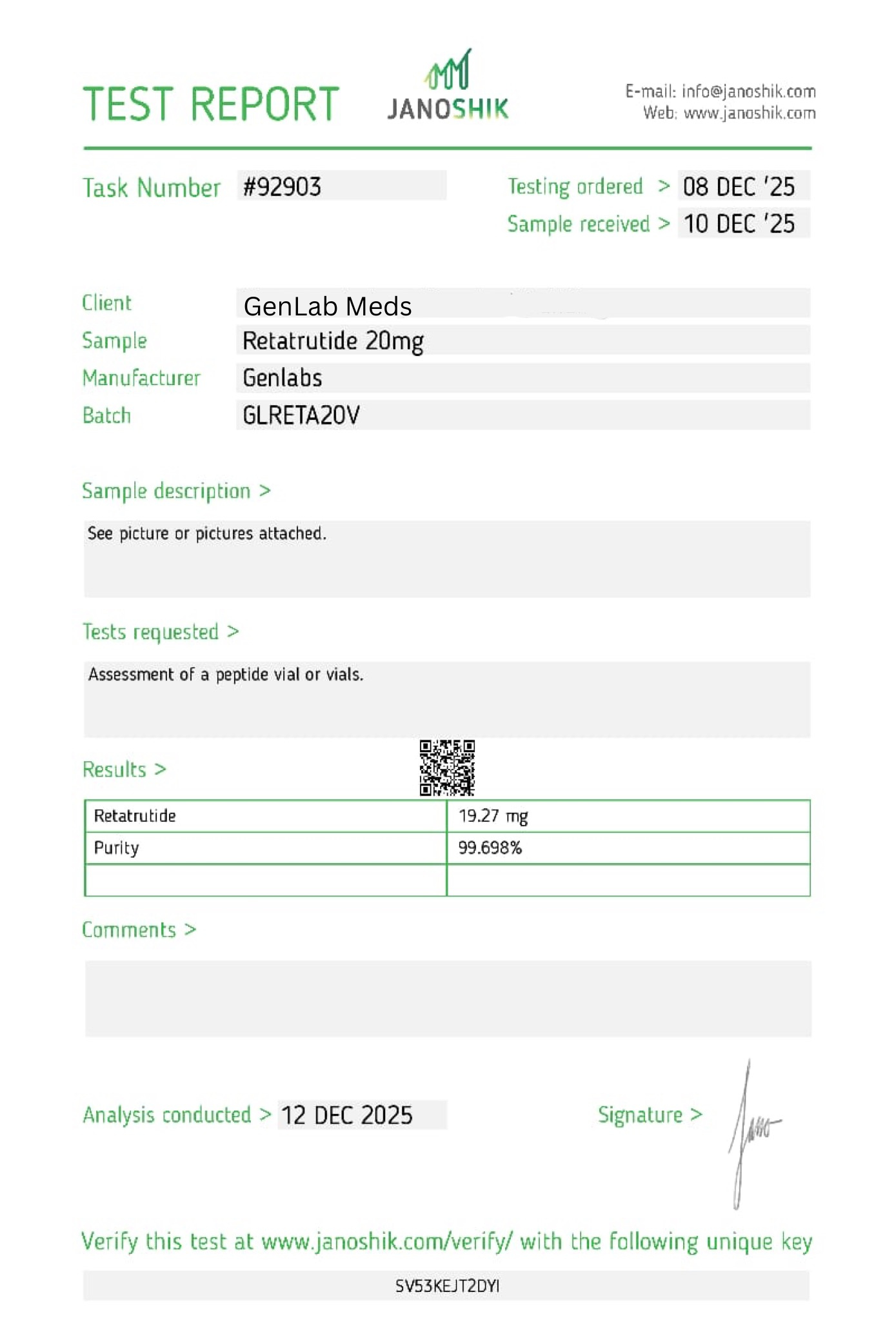
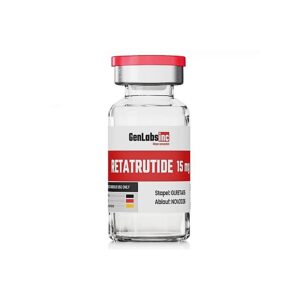
RETATRUTIDE 20MG VIAL (WITH BACTERIOSTATIC WATER) – GENLABS
$140.00
1 VIAL – 20 MG RETATRUTIDE ( DRIED FREEZE POWDER )
Benefits:
- Supports fat loss and weight management.
- Helps regulate appetite and food intake.
- Enhances metabolic rate and energy expenditure.
- Supports overall metabolic health.
- Aids in achieving a healthier body composition.
Retatrutide 20mg Vial – Research Peptide
Retatrutide 20mg is an investigational peptide associated with research into GIP, GLP-1, and glucagon receptor signaling. Retatrutide is being studied as a first-in-class triple hormone receptor agonist, making it an important subject of ongoing metabolic and pharmaceutical research.
This Retatrutide 20mg vial is presented for qualified laboratory research purposes. Retatrutide is currently investigational and has not been approved by the FDA for human use.
Retatrutide 20mg Product Overview
Retatrutide, also known as LY3437943, is a peptide compound developed by Eli Lilly and studied for its activity across three hormone receptor pathways:
- GIP — glucose-dependent insulinotropic polypeptide
- GLP-1 — glucagon-like peptide-1
- Glucagon
Unlike compounds that primarily target a single receptor, retatrutide is being investigated for its combined activity across these three pathways. This mechanism has generated significant interest in research involving metabolism, energy regulation, glucose control, and body-weight biology.
What Is Retatrutide 20mg?
Retatrutide 20mg refers to a research vial containing 20mg of retatrutide according to the product specification.
Retatrutide is an investigational triple receptor agonist. Its research profile is particularly notable because a single molecule activates receptors associated with GIP, GLP-1, and glucagon signaling.
Clinical researchers are studying retatrutide in several areas, including obesity, type 2 diabetes, cardiovascular disease, obstructive sleep apnea, knee osteoarthritis, and other metabolic conditions.
How Retatrutide Works
Retatrutide’s research mechanism involves three receptor pathways. Each pathway has a distinct biological role, which is why retatrutide is commonly described as a triple agonist.
GLP-1 Receptor Activation
GLP-1 signaling is involved in several physiological processes, including:
- Glucose-dependent insulin secretion
- Appetite and satiety signaling
- Gastrointestinal function
- Glucose metabolism
GLP-1 receptor activity is already an established area of pharmaceutical and metabolic research.
GIP Receptor Activation
GIP is an incretin hormone involved in metabolic signaling.
Research into GIP receptor activation includes investigation of:
- Glucose-dependent insulin secretion
- Nutrient metabolism
- Energy regulation
- Interactions with other metabolic pathways
Glucagon Receptor Activation
Glucagon plays an important role in energy and glucose metabolism.
Research involving glucagon receptor signaling includes investigation of:
- Energy utilization
- Glucose regulation
- Lipid metabolism
- Energy expenditure
The combination of these three receptor targets is one of the defining characteristics of retatrutide research.
Retatrutide Research
Retatrutide is currently being evaluated in Phase 3 clinical research.
In 2026, Eli Lilly reported results from multiple Phase 3 studies investigating retatrutide in adults with obesity and related metabolic conditions. The company reported positive topline results from TRIUMPH-1, TRIUMPH-2, and TRIUMPH-3 and stated that it plans to submit a Biologics License Application to the FDA in the first quarter of 2027.
These clinical studies are helping researchers understand retatrutide’s potential effects on body weight, glycemic measures, and other metabolic outcomes.
Because research and regulatory evaluation are ongoing, retatrutide should be described as an investigational compound, rather than an approved medication.
Retatrutide 20mg Research Applications
Retatrutide is of interest to researchers investigating several biological and metabolic pathways.
Potential areas of laboratory and scientific investigation include:
- GIP receptor signaling
- GLP-1 receptor signaling
- Glucagon receptor signaling
- Incretin biology
- Glucose metabolism
- Energy metabolism
- Appetite and satiety pathways
- Body-weight regulation
- Metabolic signaling
- Receptor agonist activity
Research involving investigational compounds should be conducted only by appropriately qualified researchers using suitable laboratory procedures.
Retatrutide 20mg Specifications
| Product Information | Details |
|---|---|
| Product | Retatrutide 20mg |
| Form | Dried freeze powder |
| Quantity | 20mg per vial |
| Compound | Retatrutide |
| Research targets | GIP, GLP-1 and glucagon receptors |
| Intended purpose | Laboratory research |
| Product category | Research peptide |
Retatrutide vs. Semaglutide and Tirzepatide
Retatrutide, semaglutide, and tirzepatide are different compounds with different receptor profiles.
Semaglutide primarily targets the GLP-1 receptor.
Tirzepatide targets both GIP and GLP-1 receptors.
Retatrutide is being investigated as a triple receptor agonist targeting GIP, GLP-1, and glucagon receptors.
This distinction is important when comparing the three compounds from a research perspective.
| Compound | Primary research receptor targets |
|---|---|
| Semaglutide | GLP-1 |
| Tirzepatide | GIP + GLP-1 |
| Retatrutide | GIP + GLP-1 + glucagon |
The additional glucagon receptor activity is one of the main scientific characteristics that distinguishes retatrutide from currently established incretin-based compounds.
Why Retatrutide Is Important in Metabolic Research
Retatrutide has attracted substantial research interest because it combines three receptor targets within a single molecule.
The scientific rationale behind this approach is to investigate how coordinated GIP, GLP-1, and glucagon signaling may influence multiple aspects of metabolic physiology.
Recent Phase 3 research has produced substantial interest in retatrutide’s effects on body weight and glycemic measures, although regulatory review and further clinical evaluation remain ongoing.
Retatrutide 20mg Frequently Asked Questions
What is Retatrutide 20mg?
Retatrutide 20mg refers to a vial containing 20mg of the investigational peptide retatrutide according to the listed product specification.
What receptors does retatrutide target?
Retatrutide is being investigated as a triple receptor agonist targeting GIP, GLP-1, and glucagon receptors.
Is retatrutide FDA approved?
No. As of August 2026, retatrutide remains investigational and has not been approved by the FDA.
What is retatrutide being studied for?
Clinical research is evaluating retatrutide in obesity, type 2 diabetes, and several other metabolic and related conditions.
Is retatrutide the same as semaglutide?
No. They are different compounds. Semaglutide primarily targets GLP-1 receptors, while retatrutide is being investigated for activity at GIP, GLP-1, and glucagon receptors.
Is retatrutide the same as tirzepatide?
No. Tirzepatide targets GIP and GLP-1 receptors, whereas retatrutide is being studied as a GIP, GLP-1, and glucagon triple agonist.
What does 20mg mean?
The 20mg designation refers to the stated amount of retatrutide contained in the product vial.
Important Research-Use Information
Retatrutide is an investigational compound and is not currently an FDA-approved medication.
This product information is provided for laboratory and scientific research purposes and is not intended to provide medical advice, prescribing instructions, dosing instructions, or treatment recommendations.
Do not use research compounds for human or veterinary administration. Qualified researchers should follow applicable laboratory procedures, institutional requirements, and all relevant laws and regulations.
Retatrutide Research Summary
Retatrutide represents an important area of current metabolic research because of its unique GIP + GLP-1 + glucagon triple-agonist mechanism.
With multiple Phase 3 studies underway or recently reported, researchers continue to evaluate its pharmacological profile, efficacy, and safety. Regulatory evaluation is also ongoing, so information about retatrutide should be interpreted in the context of its current investigational status.
For researchers interested in triple-receptor agonists, incretin biology, and metabolic signaling, Retatrutide 20mg provides a clearly defined research target for laboratory investigation.
Research Disclaimer
For research use only. Not for human or veterinary use. Retatrutide is an investigational compound and has not been approved by the FDA. This page does not provide medical advice, dosing instructions, or recommendations for human administration.
Be the first to review “RETATRUTIDE 20MG VIAL (WITH BACTERIOSTATIC WATER) – GENLABS”
Related products


Reviews
There are no reviews yet.