-
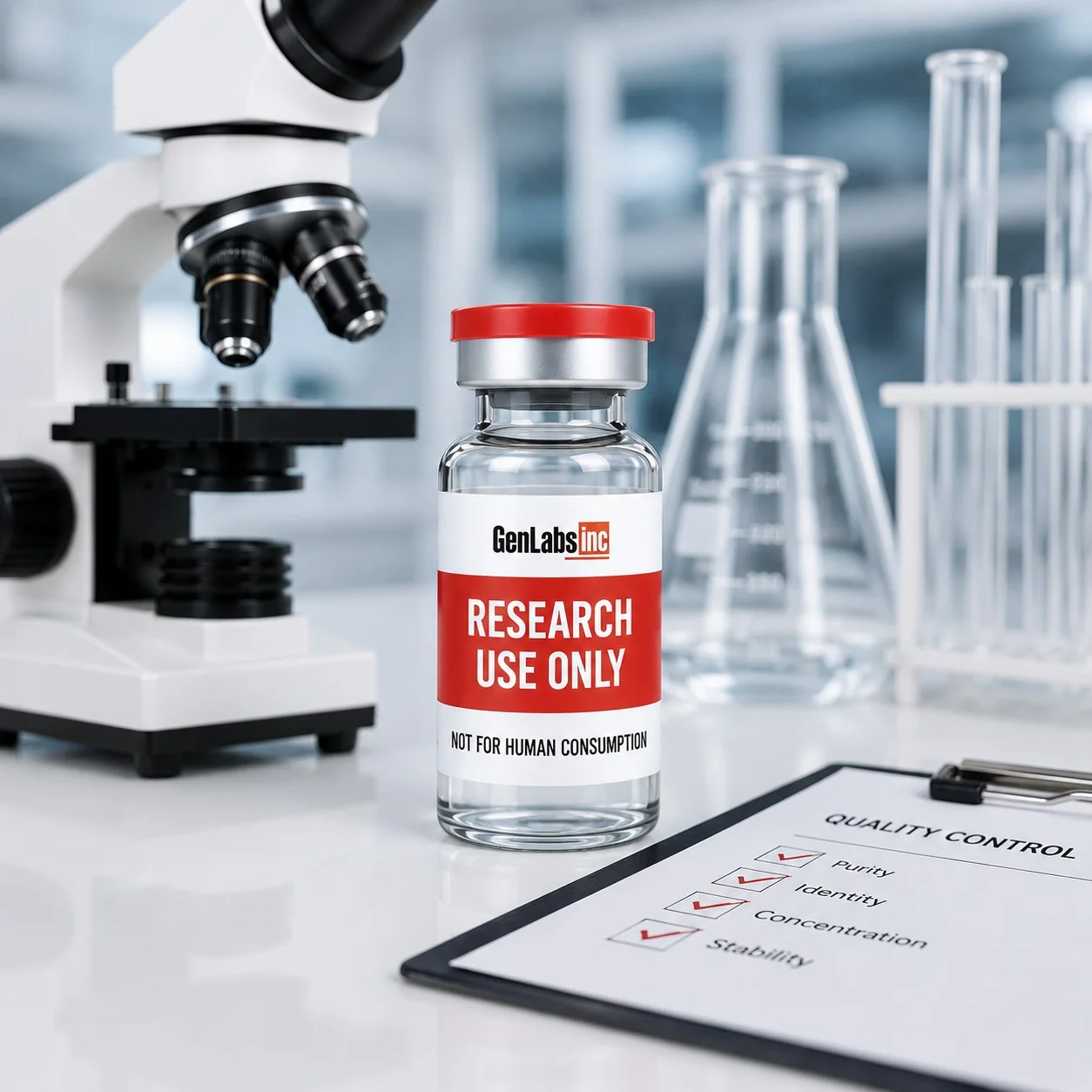
Products are supplied strictly for laboratory and scientific research — not for human or veterinary use.
Laboratory concentration calculations connect the amount of material, solution volume and target assay condition. They are not human dosing instructions. Researchers must use verified product identity, actual peptide content where required, appropriate volumetric equipment and a validated protocol.
Mass concentration is calculated as:
Concentration = mass ÷ total solution volume
If 5mg of material is brought to a total solution volume of 2mL, the nominal mass concentration is:
5mg ÷ 2mL = 2.5mg/mL
This example uses the stated mass. Quantitative work may need a correction based on measured peptide content, water or counter-ion data.
One milligram equals 1,000 micrograms. Therefore:
2.5mg/mL × 1,000 = 2,500µg/mL
Keep units attached to every value. Most calculation errors occur when mass or volume units are mixed without conversion.
For a simple dilution, laboratories often use:
C1 × V1 = C2 × V2
Where C1 is the stock concentration, V1 is the stock volume required, C2 is the target concentration and V2 is the final total volume.
For example, to prepare 10mL of a 100µg/mL working solution from a 1,000µg/mL stock:
V1 = (100µg/mL × 10mL) ÷ 1,000µg/mL = 1mL
The laboratory would use 1mL of stock and bring the preparation to a final total volume of 10mL with a validated compatible diluent.
Molar concentration requires molecular weight:
Moles = mass in grams ÷ molecular weight in g/mol
Molarity = moles ÷ solution volume in liters
Use the molecular form specified in the analytical documentation. Salt, counter-ion and hydration state can affect mass-based conversions.
No. A stated mass becomes a concentration only after the final solution volume is defined.
Not automatically. Review the difference between purity, identity and content.
No. It is limited to laboratory solution mathematics for controlled scientific research.
Browse laboratory supplies and product specifications before planning a research workflow.