Peptide Education
Why Some Peptides Do Not Dissolve in Water: A Laboratory Solubility Guide
31
Aug
Aug

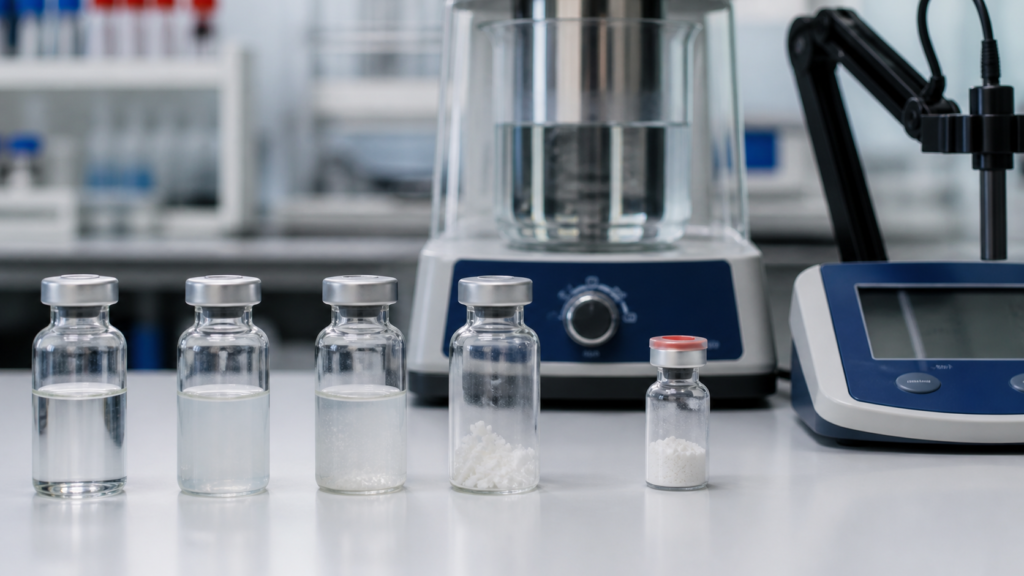
Peptide solubility is determined by more than the amount of liquid added to a vial. Amino-acid composition, net charge, hydrophobicity, pH, concentration, temperature and solvent compatibility can all influence whether a peptide forms a clear solution, suspension, gel or precipitate.
There is no universal solvent that is correct for every peptide and every assay.
Charged residues interact with water and often improve aqueous solubility. The peptide's net charge changes with pH, so a solvent system that works under one condition may fail under another. Strong pH changes can also alter peptide stability or compatibility with the downstream method.
Sequences rich in hydrophobic amino acids may aggregate or resist dissolution in water. Organic co-solvents are sometimes evaluated in laboratory workflows, but the solvent must be compatible with the peptide, analytical method and biological assay.
A peptide may dissolve at a low concentration and precipitate at a higher one. Conversely, very dilute peptides can be vulnerable to adsorption on container surfaces. Laboratory planning should define the required final concentration and acceptable solvent composition before the whole sample is used.
Major supplier guidance recommends evaluating solubility on a small portion when the correct solvent is uncertain. This protects the remaining material if the first condition produces precipitation, gel formation or incompatibility.
Visible particles, cloudiness or gel formation suggest that the peptide may not be fully dissolved. Sonication can help disperse material, but it does not prove molecular solubility. Record appearance and use an analytical check appropriate to the experiment.
A solvent that dissolves the peptide may interfere with cells, enzymes, chromatography or detection. Consider:
No. Sequence and experimental conditions determine solubility.
No. A dispersed suspension can still contain undissolved material. Follow a validated procedure and avoid handling that may damage the product.
No. Use the chart as a starting framework and confirm suitability for the individual peptide and assay.
Explore the GenLab Meds research catalog for product formats and stated quantities. Product pages do not replace a laboratory's responsibility to validate preparation conditions.
Sources: MilliporeSigma peptide solubility guidelines; Thermo Fisher standard-peptide instructions