
-
Products are supplied strictly for laboratory and scientific research — not for human or veterinary use.
Peptide research includes laboratory experiments, animal models and controlled human studies. These approaches answer different questions: a change in cells, animal behavior or hormone levels does not automatically establish a clinical benefit.
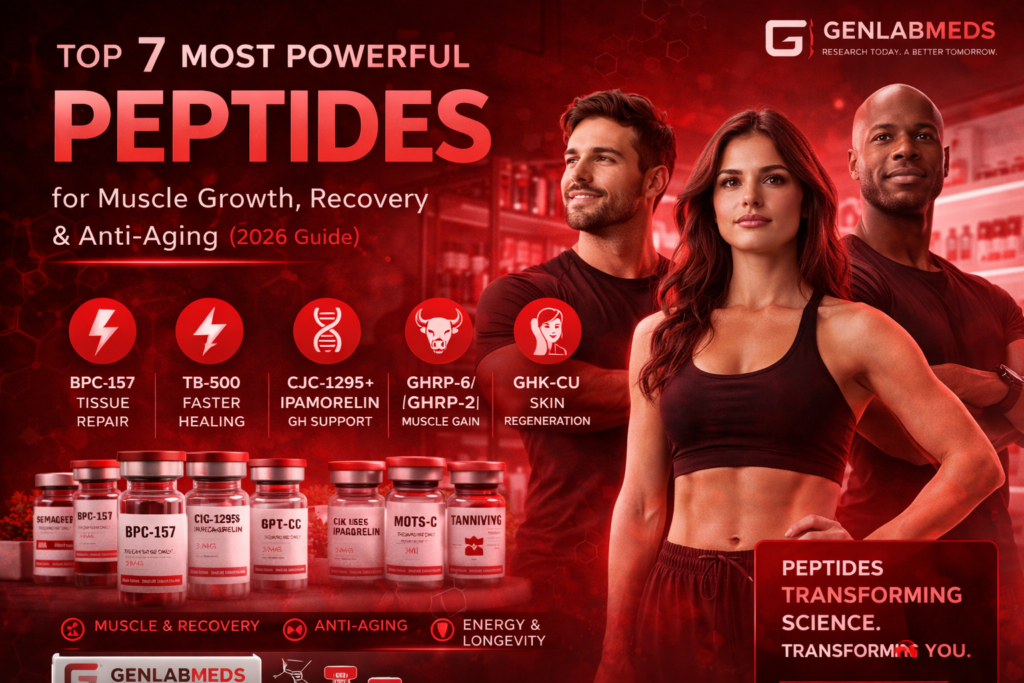
This overview examines seven research topics—not seven recommended treatments. It does not rank compounds for muscle building, injury recovery, tanning or anti-aging. The cited studies illustrate evidence and its limitations; this is not a systematic review.
Researchers have investigated BPC-157 in surgically injured rat tendons and cultured tendon cells. Those experiments cannot establish faster recovery from human sports injuries or validate a separately supplied commercial product. Primary tendon study.
A study of thymosin beta-4 examined wound repair in rats and cell migration in laboratory assays. It should not be treated as direct evidence for any product labeled TB-500 without establishing that the tested molecule and supplied material match. Similar naming does not establish equivalence. Primary wound-model study.
Short controlled trials of a long-acting CJC-1295 analog measured growth hormone and IGF-I responses in healthy adults. They did not establish improved muscle strength, injury recovery or lifespan. Their findings should not automatically be transferred to differently identified “without DAC” materials or blends. CJC-1295 clinical study.
The original Ipamorelin pharmacology paper described cell and animal experiments. It does not demonstrate that combining Ipamorelin with another compound produces additional benefits in people. Ipamorelin pharmacology study.
A small controlled GHRP-2 study in seven healthy men investigated short-term food intake and hormone responses—not sustained muscle growth. Those results do not establish equivalent effects for GHRP-6 or other related compounds. GHRP-2 human study.
An early experiment reported changes in collagen synthesis in cultured fibroblasts exposed to GHK-Cu. This laboratory endpoint does not establish reversal of human aging, hair regrowth or safety for another formulation or route of exposure. Primary fibroblast study.
Research on MOTS-c has investigated mitochondrial signaling and metabolic regulation, including experiments in mice. These findings raise questions for further investigation; they do not demonstrate that a commercial MOTS-c product extends human lifespan. Primary metabolic study.
A phase-I pilot involving three men reported pigmentation changes and adverse effects. It does not establish protection against sunburn or skin cancer, long-term safety, or an appropriate consumer tanning use. Primary pilot study.
Before accepting a claim, ask:
The FDA has identified safety concerns and evidence gaps for several substances discussed here. Consult its current substance-specific information rather than assuming that research interest establishes safety. FDA safety information.
A published paper is not a certificate of analysis for a commercial vial. Material evaluation requires relevant batch identifiers, appropriate analytical methods and documentation matched to the supplied lot. Purity alone does not establish sterility or clinical safety.
For questions about documentation associated with a listing, contact GenLab Meds. Documentation availability must be confirmed, not assumed.
This article provides scientific context, not dosing, preparation, administration or treatment instructions. A research-use label is not proof of safety or authorization for human use.