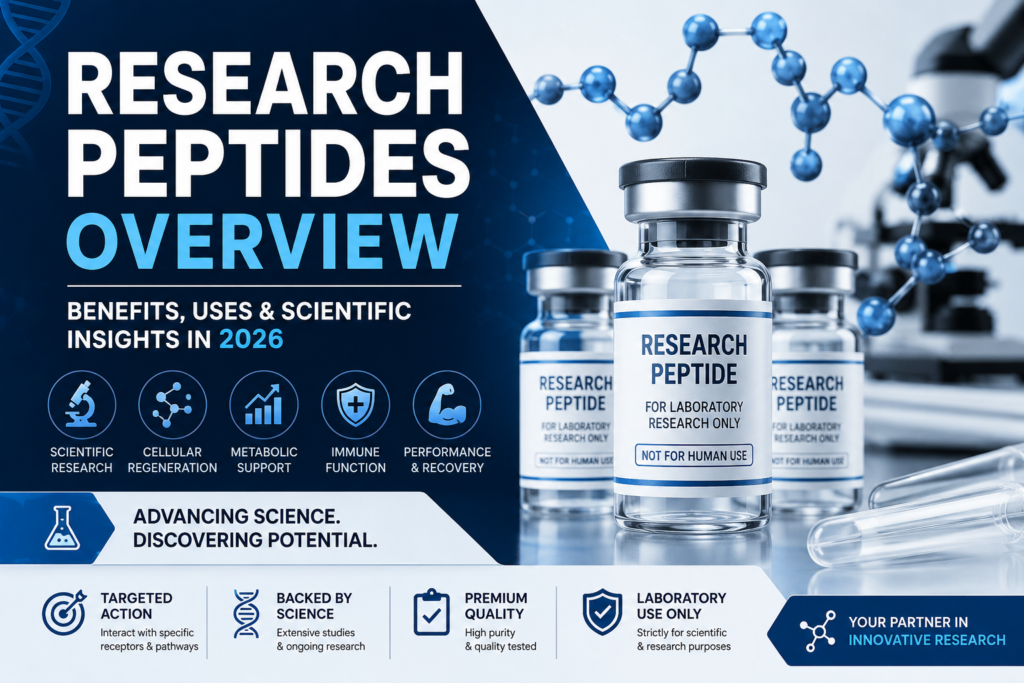

-
Products are supplied strictly for laboratory and scientific research — not for human or veterinary use.
The demand for peptide-based research continues to grow as scientists uncover new ways these compounds influence biological processes. This Research Peptides Overview provides a comprehensive look at what research peptides are, how they function, and why they have become essential tools in modern laboratories. Peptides are short chains of amino acids that serve as signaling molecules throughout the body, helping regulate numerous physiological activities.
As interest in regenerative medicine, metabolic studies, and hormone optimization expands, researchers increasingly rely on peptides to better understand complex biological pathways. This Research Peptides Overview examines the science behind peptide research and highlights the benefits that make these compounds valuable across multiple scientific disciplines. Whether studying tissue repair, cellular communication, or metabolic function, a thorough Research Peptides Overview helps researchers make informed decisions when selecting peptide compounds for laboratory investigations.
A Research Peptides Overview begins with understanding the fundamental role of peptides. Peptides are naturally occurring chains of amino acids that act as messengers within the body. They help coordinate communication between cells and influence various biological functions, including growth, repair, metabolism, and immune responses.
Research peptides are synthesized specifically for laboratory and scientific investigation purposes. Scientists use these compounds to study receptor interactions, hormonal signaling, cellular regeneration, and metabolic regulation. A comprehensive Research Peptides Overview reveals that peptides are often preferred in research because of their ability to target specific biological pathways with precision.
The following are examples discussed in peptide literature and research listings, not a popularity ranking or recommendation:
Each peptide serves a unique purpose in scientific research, making a detailed Research Peptides Overview valuable for understanding their individual applications.
An important part of any Research Peptides Overview is understanding how peptides function at the cellular level. Research peptides interact with receptors located on cell surfaces and within tissues. Once activated, these receptors trigger biological responses that researchers can observe and analyze.
Peptides act as biological messengers, transmitting information between cells. This communication helps regulate growth, repair, and metabolic activity.
Some peptides are investigated for activity at particular receptors. Selectivity and unintended effects must be assessed experimentally; targeted activity does not imply that unrelated systems are unaffected.
Certain peptides influence hormone secretion or mimic naturally occurring hormones. Through this mechanism, researchers can study growth hormone production, appetite regulation, and metabolic responses.
Several peptides are widely researched for their potential influence on cellular repair and tissue regeneration. These studies contribute to ongoing scientific exploration in recovery and healing processes.
For definitions and material-evaluation basics, read our Beginner’s Guide to research peptides. This overview focuses on research topics, not recommendations for human use.
The following headings describe areas of investigation, not demonstrated treatment benefits or a ranking of products. Findings apply to the exact material, experimental model and outcomes studied.
Research peptides are often studied for their role in tissue repair and cellular regeneration. Their targeted activity makes them valuable tools for investigating healing mechanisms.
Semaglutide, tirzepatide and retatrutide differ in receptor targets and regulatory status. Approval of a specific prescription medicine does not validate research materials sold under a similar compound name. See our GLP-1 research overview for these distinctions.
Growth hormone secretagogues such as CJC-1295 and Ipamorelin help researchers investigate hormonal pathways and endocrine function.
Peptides are commonly utilized in studies involving muscle recovery, physical performance, and tissue adaptation.
A defined molecular target can help frame a research question, but data quality also depends on material identity, controls, analytical methods and experimental design.
As peptide science evolves, these compounds continue to reveal new insights into biological systems, contributing to advancements across multiple research fields.
A research-use label alone does not establish legal authorization for a product or intended use. Requirements depend on the exact substance, claims, activity and jurisdiction; obtain qualified advice for a specific situation.
A Research Peptides Overview demonstrates that peptides help scientists investigate cellular communication, hormone activity, metabolism, and tissue regeneration.
Use storage conditions and in-use periods supported for the specific material and formulation. There is no universal refrigeration or shelf-life rule. See our storage evidence guide.
Peptides consist of shorter amino acid chains, while proteins are larger and more structurally complex molecules.
No popularity ranking is established here. Select materials by the research question, exact identity, available evidence and applicable documentation—not marketing prominence.
This Research Peptides Overview highlights why peptides remain among the most important compounds in modern scientific research. Their ability to interact with specific receptors and biological pathways allows researchers to study regeneration, metabolism, hormonal regulation, and cellular communication with exceptional precision.
As scientific interest continues to grow in 2026, peptides are expected to play an increasingly significant role in advancing laboratory discoveries. Whether exploring tissue repair mechanisms or metabolic pathways, a comprehensive Research Peptides Overview provides the foundation needed to understand the evolving landscape of peptide science.
Review applicable batch identifiers, test methods and analytical records. Purity alone does not establish sterility, safety or fitness for every experiment, and supplier claims do not guarantee successful studies.
Review individual specifications and clarify missing information before selecting laboratory materials.
Browse our complete peptide catalog and find the research compounds your studies require today.
For study-specific examples and their limitations, read our seven peptide research topics guide. For missing product specifications or documentation, contact GenLab Meds rather than assuming testing has been performed. These materials are not intended for human or veterinary use, consumption, diagnosis or treatment.